



Role: Senior Product Design (Freelance)
Project: Global B2B SaaS / IoT Platform / Regulated Environment
Client: Jungheinrich Digital Solutions AG & Co. KG (JDS)
Maintain control.
Fleet management means keeping utilization, safety-related events, and costs in view at all times – across different regulatory requirements and multiple organizations. Maintaining this overview is what determines economic viability, operational reliability, and planning certainty.
What matters is not just the availability of information, but the ability to derive actionable options from it quickly and confidently.
As platforms mature, requirements shift: from pure functionality toward structural scalability and system-wide consistency.
The goal: to transform operational complexity into clear, traceable, and scalable foundations for decision-making.

Insights
Data becomes responsibility.
IoT makes fleet data visible – in real time, across locations, and throughout the organization.
But transparency alone does not create control. With every metric comes responsibility: for costs, compliance, and stable operations.
What matters is not usage intensity, but the specific decision-making context. The challenge lies not in displaying data, but in structuring how it all connects.
A system like this must remain comprehensive without overwhelming – and flexible without losing consistency.
RIGHTS AND ROLES MANAGEMENT
DEFINING
ACCEESS.
Insight: Ready for scale.
As functional depth and international usage grew, the FMS role and permission model was subjected to a strategic review.
Across various markets, recurring feedback from Sales, DPM, and customers had accumulated. Rather than translating these signals into isolated role additions, a structured health check was initiated.
The goal was to validate assumptions and rigorously assess how future-proof the access framework really is.
1. Structured evaluation.
To validate findings, international interviews were conducted with internal stakeholders and customers. The focus was not on individual permission requests, but on structural patterns in how roles and responsibilities are handled.
It became clear that a robust access model always operates in the tension between clarity and flexibility: too little differentiation limits room for action, while too much increases complexity and governance demands.

2. A scalable framework.
Rather than isolated role additions, structural principles were defined to guide future extensions. The result was a clear foundation for decision-making on the strategic evolution of the access framework – with transparent trade-offs between flexibility, consistency, and controllability.
3rd PARTY TRUCK INTEGRATION
BEYOND
OUR OWN.
Insight: Opening up.
As market penetration grew, the FMS evolved from a manufacturer-specific system into a comprehensive fleet platform. The ambition was clear: customers should be able to map their entire vehicle landscape consistently within a single system logic – regardless of manufacturer.
The challenge lay not only in integrating external data sources, but in the architecture of the entire product: five product teams, twelve modules, different data models, and independent roadmaps.
A module-by-module rollout was not an option. Opening up the system had to be orchestrated consistently, scalably, and across the entire product – starting with a shared MVP.
1. Aligning the foundation.
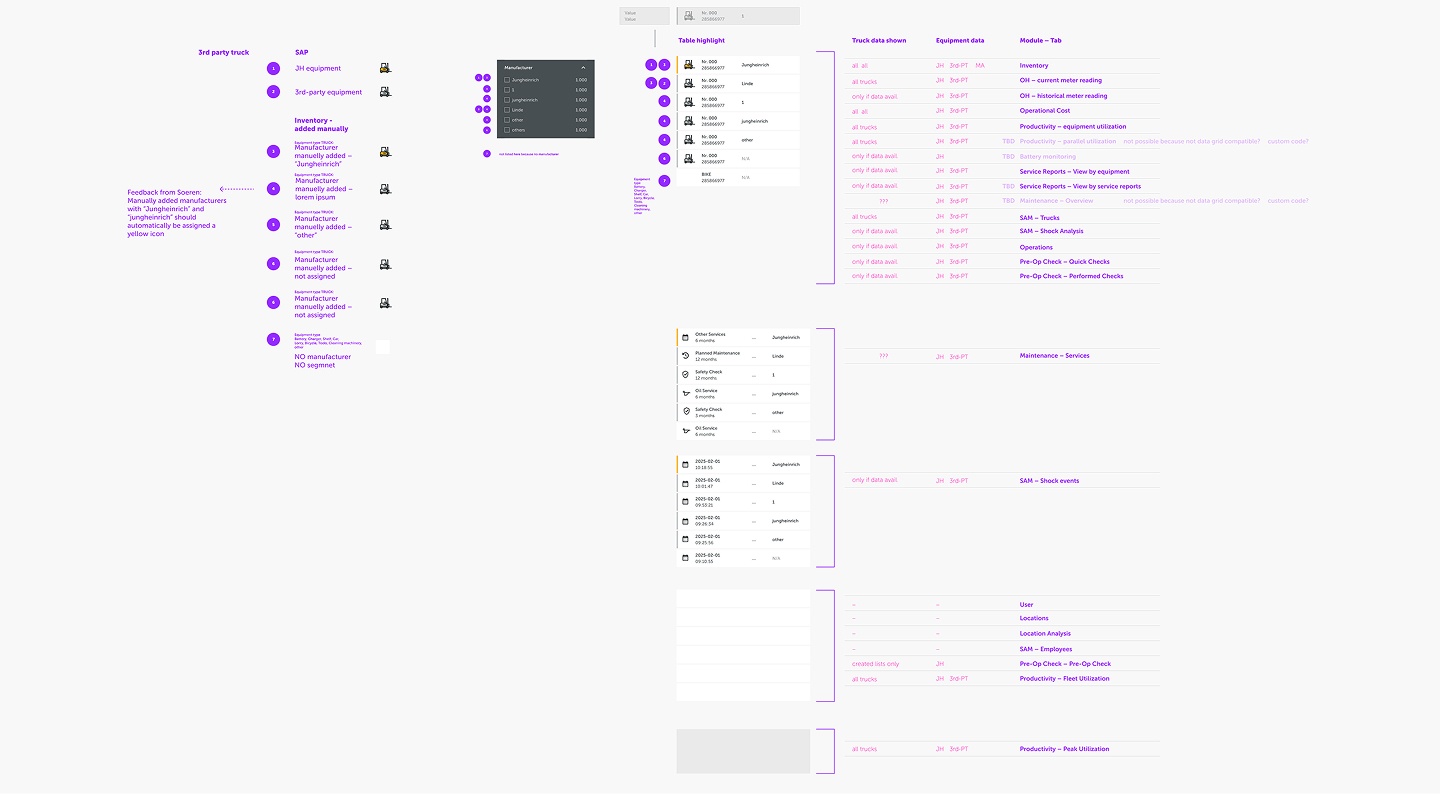
The integration required cross-cutting alignment of core system structures. The goal was to create a consistent framework that enables a platform-wide rollout while avoiding fragmented individual implementations.
The focus was not solely on the UX/UI concept, but on harmonizing the underlying structures: data models, segmentation logic, and technical prerequisites across both front- and backend.
Integration decisions had to be viable across the entire product and could not cause inconsistent effects on analytics or reporting functions.
On this basis, a shared MVP framework was defined that served as a binding reference point for all teams involved.
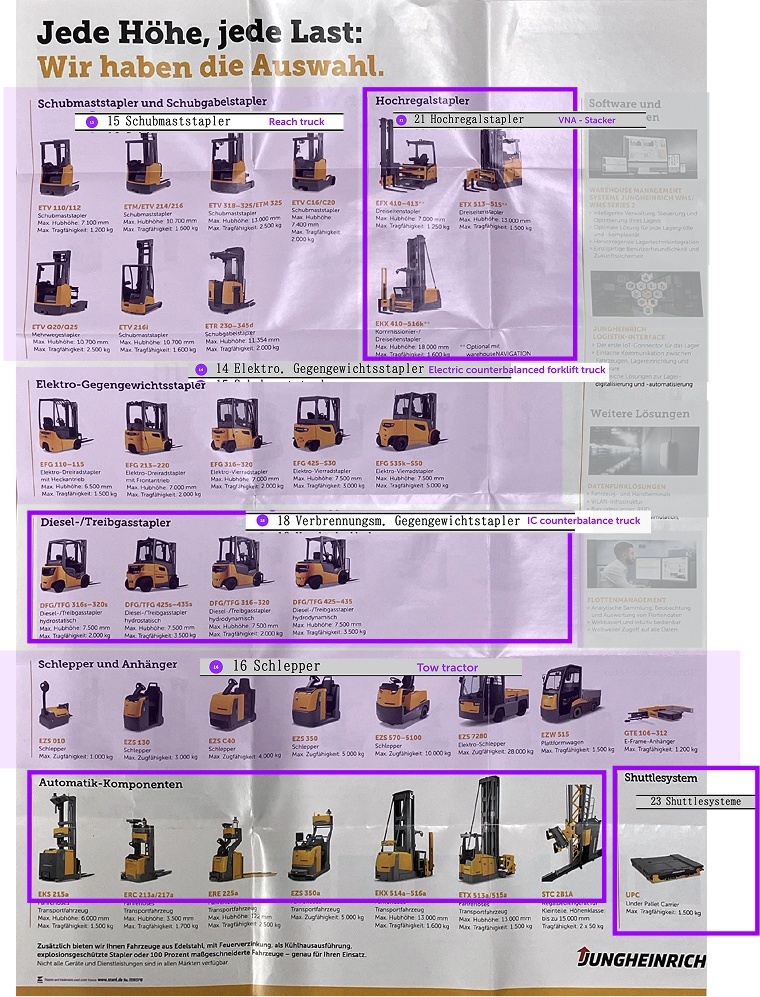
2. Clarity at a glance.
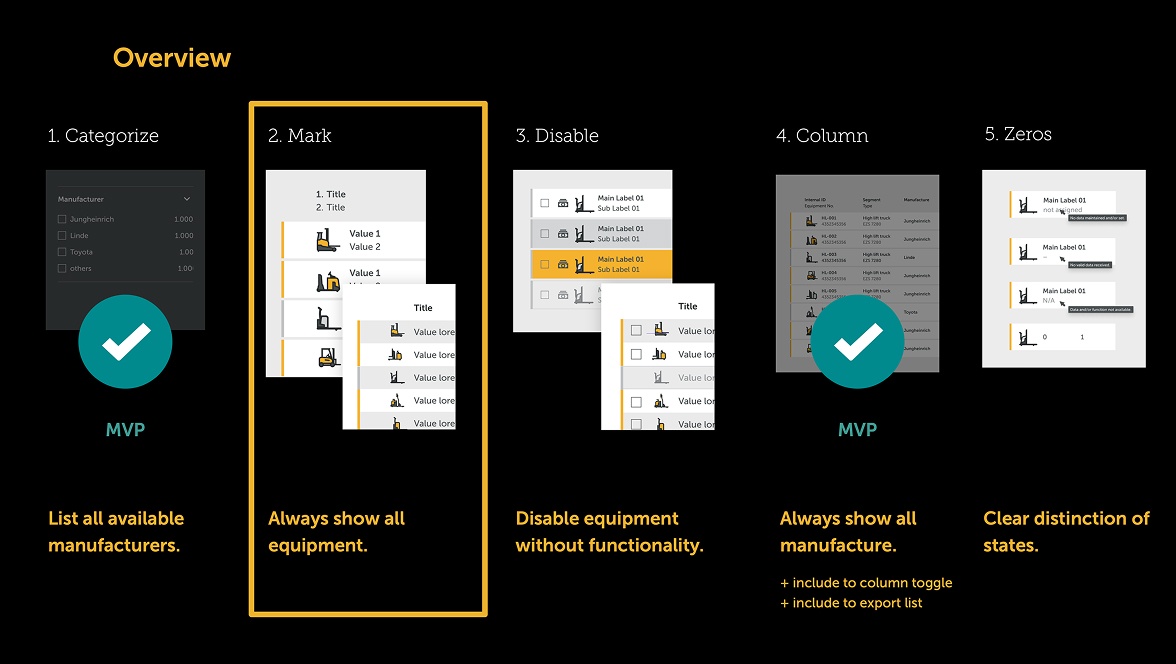
The visual integration was designed so that external vehicles are clearly identifiable without overriding the existing system logic.
A consistent labeling system and an extended icon set enable quick differentiation of various device types across overviews, tables, and filters. The goal was to make heterogeneity visible without adding visual complexity.
In parallel, display rules and filter logic were harmonized across the product to ensure a unified understanding across all modules.
From realism to system.
The visual evolution from photorealistic representation to a structured, abstraction-based icon system — designed for recognition, consistency and scalability. From left to right: original photo of a Jungheinrich forklift / previous system icon / new icon (Jungheinrich) / new icon (corresponding forklift from a third-party manufacturer)


Clarity without realism.
A structured icon system that balances abstraction and recognition — detailed enough for orientation, abstract enough to remain consistent across heterogeneous fleets.


Consistency across contexts.
Each table type follows the same color and icon principles — adapted to its context while maintaining a unified visual system.
3. Consistency first.
The rollout was deliberately designed as a platform-wide MVP rather than a module-by-module extension. This ensured that new functionality was not developed in isolation, but embedded within a unified system logic.
Through early alignment with Product, Engineering, and Management, varying stages of development were consolidated, enabling a coherent rollout across all modules.
As a result, the opening toward heterogeneous fleet structures was not implemented as an add-on, but anchored as an integral part of the existing platform architecture.
LOCATION BASED ANALYSE
DECIDE
WITH DATA.
Insight: Designed for decisions.
The Location Analysis module enables aggregated evaluation of fleet data at the site and site group level. As usage grew among analysts, regional and international management roles, the expectation evolved from providing a simple overview to delivering robust foundations for decision-making.
The focus was not on expanding individual metrics, but on the structural advancement of analytical capability – with due consideration for scalability and system stability.

1. Meaningful timeframes.
Temporal comparability was designed to support analytical depth while maintaining a consistent calculation logic. Existing comparison models such as Month-to-Date and Year-to-Date were made visible as clear filter options and selectively extended with additional periods such as Single Month and Single Quarter.
This created a structured time framework that enables well-founded comparisons without unnecessarily complicating the system architecture.

2. Ready by default.
Working with site groups was further developed to efficiently map international organizational structures. In addition to individually definable groups, permission-based predefined groups were introduced that simplify comparability and reduce administrative effort.
This resulted in a scalable structure that supports both standardization and individual analysis requirements.
3. Depth on demand.
Aggregated metrics such as Damage Costs or Fleet Utilization only realize their strategic value when they are comparable and differentiable across multiple levels.
Within the module, the entire fleet can be viewed and directly compared against individual sites or site groups. Each of these levels was designed so that additional layers of analysis can be unlocked as needed. An expandable detail section allows for differentiated examination by segments and material groups, creating transparency.
The underlying structure is intentionally designed to be extensible. Additional parameters can be integrated without altering the existing system logic. This creates an analytics architecture that keeps pace with growing requirements and supports well-founded decisions.